Storage Stucture


  • Main Memory--Computer data storage, often called storage or memory, refers to computer components, devices, and recording media that retain digital data used for computing for some interval of time. Computer data storage provides one of the core functions of the modern computer, that of information retention. It is one of the fundamental components of all modern computers, and coupled with a central processing unit (CPU, a processor), implements the basic computer model used since the 1940s.In contemporary usage, memory usually refers to a form of semiconductor storage known as random access memory (RAM) and sometimes other forms of fast but temporary storage. Similarly, storage today more commonly refers to mass storage - optical discs, forms of magnetic storage like hard disks, and other types slower than RAM, but of a more permanent nature. Historically, memory and storage were respectively called primary storage and secondary storage.


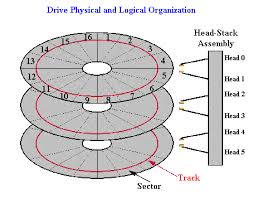
  • Magnetic Disk-Magnetic Disk-Magnetic storage and magnetic recording are terms from engineering referring to the storage of data on a magnetized medium. Magnetic storage uses different patterns of magnetization in a magnetizable material to store data and is a form of non-volatile memory. The information is accessed using one or more read/write heads. As of 2009, magnetic storage media, primarily hard disks, are widely used to store computer data as well as audio and video signals. In the field of computing, the term magnetic storage is preferred and in the field of audio and video production, the term magnetic recording is more commonly used. The distinction is less technical and more a matter of preference10.Storage Hierarchy-The hierarchical arrangement of storage in current computer architectures is called the memory hierarchy. It is designed to take advantage of memory locality in computer programs. Each level of the hierarchy has the properties of higher bandwidth, smaller size, and lower latency than lower levels.


  • Moving Head Disk Mechanism-


  • Magnetic Tapes-Magnetic tape is a medium for magnetic recording generally consisting of a thin magnetizable coating on a long and narrow strip of plastic. Nearly all recording tape is of this type, whether used for recording audio or video or for computer data storage. It was originally developed in Germany, based on the concept of magnetic wire recording. Devices that record and playback audio and video using magnetic tape are generally called tape recorders and video tape recorders respectively. A device that stores computer data on magnetic tape can be called a tape drive, a tape unit, or a streamer.

Storage Hierarchy


  • Caching-In computer science, a cache (pronounced /kæʃ/) is a collection of data duplicating original values stored elsewhere or computed earlier, where the original data is expensive to fetch (owing to longer access time) or to compute, compared to the cost of reading the cache. In other words, a cache is a temporary storage area where frequently accessed data can be stored for rapid access. Once the data is stored in the cache, it can be used in the future by accessing the cached copy rather than re-fetching or recomputing the original data.
    A cache has proven to be extremely effective in many areas of computing because access patterns in typical computer applications have locality of reference. There are several kinds of locality, but this article primarily deals with data that are accessed close together in time (temporal locality). The data might or might not be located physically close to each other (spatial locality).


  • Coherency-In computing, cache coherence (also cache coherency) refers to the integrity of data stored in local caches of a shared resource. Cache coherence is a special case of memory coherence.
    When clients in a system maintain caches of a common memory resource, problems may arise with inconsistent data. This is particularly true of CPUs in a multiprocessing system. Referring to the "Multiple Caches of Shared Resource" figure, if the top client has a copy of a memory block from a previous read and the bottom client changes that memory block, the top client could be left with an invalid cache of memory without any notification of the change. Cache coherence is intended to manage such conflicts and maintain consistency between cache and memory.


  • Consistency- in theory is one that does not contain a contradiction. The lack of contradiction can be defined in either semantic or syntactic terms. The semantic definition states that a theory is consistent if it has a model; this is the sense used in traditional Aristotelian logic, although in contemporary mathematical logic the term satisfiable is used instead. The syntactic definition states that a theory is consistent if there is no formula P such that both P and its negation are provable from the axioms of the theory under its associated deductive system.
    If these semantic and syntactic definitions are equivalent for a particular logic, the logic is complete. The completeness of sentential calculus was proved by Paul Bernays in 1918 and Emil Post in 1921, while the completeness of predicate calculus was proved by Kurt Gödel in 1930. Stronger logics, such as second-order logic, are not complete.

9.Magnetic Disk

-9.Magnetic Disk-Magnetic storage and magnetic recording are terms from engineering referring to the storage of data on a magnetized medium. Magnetic storage uses different patterns of magnetization in a magnetizable material to store data and is a form of non-volatile memory. The information is accessed using one or more read/write heads. As of 2009, magnetic storage media, primarily hard disks, are widely used to store computer data as well as audio and video signals. In the field of computing, the term magnetic storage is preferred and in the field of audio and video production, the term magnetic recording is more commonly used. The distinction is less technical and more a matter of preference10.Storage Hierarchy-The hierarchical arrangement of storage in current computer architectures is called the memory hierarchy. It is designed to take advantage of memory locality in computer programs. Each level of the hierarchy has the properties of higher bandwidth, smaller size, and lower latency than lower levels.

8. Main Memory.

-Computer data storage, often called storage or memory, refers to computer components, devices, and recording media that retain digital data used for computing for some interval of time. Computer data storage provides one of the core functions of the modern computer, that of information retention. It is one of the fundamental components of all modern computers, and coupled with a central processing unit (CPU, a processor), implements the basic computer model used since the 1940s.
In contemporary usage, memory usually refers to a form of semiconductor storage known as random access memory (RAM) and sometimes other forms of fast but temporary storage. Similarly, storage today more commonly refers to mass storage - optical discs, forms of magnetic storage like hard disks, and other types slower than RAM, but of a more permanent nature. Historically, memory and storage were respectively called primary storage and secondary storage.

7.Difference of RAM and DRAM.

-Random-access memory (usually known by its acronym, RAM) is a form of computer data storage. Today, it takes the form of integrated circuits that allow stored data to be accessed in any order (i.e., at random). The word random thus refers to the fact that any piece of data can be returned in a constant time, regardless of its physical location and whether or not it is related to the previous piece of data.[1]
By contrast, storage devices such as
tapes, magnetic discs and optical discs rely on the physical movement of the recording medium or a reading head. In these devices, the movement takes longer than data transfer, and the retrieval time varies based on the physical location of the next item.
The word RAM is often associated with
volatile types of memory (such as DRAM memory modules), where the information is lost after the power is switched off. Many other types of memory are RAM, too, including most types of ROM and flash memory called NOR-Flash.


Dynamic random access memory (DRAM) is a type of
random access memory that stores each bit of data in a separate capacitor within an integrated circuit. Since real capacitors leak charge, the information eventually fades unless the capacitor charge is refreshed periodically. Because of this refresh requirement, it is a dynamic memory as opposed to SRAM and other static memory.
The advantage of DRAM is its structural simplicity: only one transistor and a capacitor are required per bit, compared to four transistors in SRAM. This allows DRAM to reach very high
density. Unlike Flash memory, it is volatile memory (cf. non-volatile memory), since it loses its data when the power supply is removed

6.Direct Memory Access.(DMA)


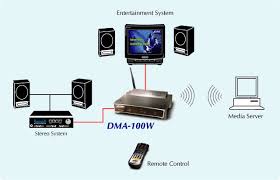
-Direct memory access (DMA) is a feature of modern computers and microprocessors that allows certain hardware subsystems within the computer to access system memory for reading and/or writing independently of the central processing unit. Many hardware systems use DMA including disk drive controllers, graphics cards, network cards and sound cards. DMA is also used for intra-chip data transfer in multi-core processors, especially in multiprocessor system-on-chips, where its processing element is equipped with a local memory (often called scratchpad memory) and DMA is used for transferring data between the local memory and the main memory. Computers that have DMA channels can transfer data to and from devices with much less CPU overhead than computers without a DMA channel. Similarly a processing element inside a multi-core processor can transfer data to and from its local memory without occupying its processor time and allowing computation and data transfer concurrency.

4.User Node.

-User-mode Linux (UML) enables multiple virtual Linux systems (known as guests) to run as an application within a normal Linux system (known as the host). As each guest is just a normal application running as a process in user space, this approach provides the user with a way of running multiple virtual Linux machines on a single piece of hardware, offering excellent security and safety without affecting the host environment's configuration or stability.